


The homeowner’s main goals were durability and long-term value. They wanted a roof that would outlast the typical asphalt shingle replacement cycle and hold up to whatever the next few hurricane seasons bring.
What Makes Standing Seam Different From Exposed-Fastener Metal Roofing
Not all metal roofs are built the same way, and the difference matters a lot more than most homeowners realize. Exposed-fastener metal roofing is attached with screws that go straight through the panel and into the roof deck. Each of those screws has a rubber grommet underneath to seal it, and over time, Florida sun and heat break those grommets down. Once a grommet fails, water finds its way in.
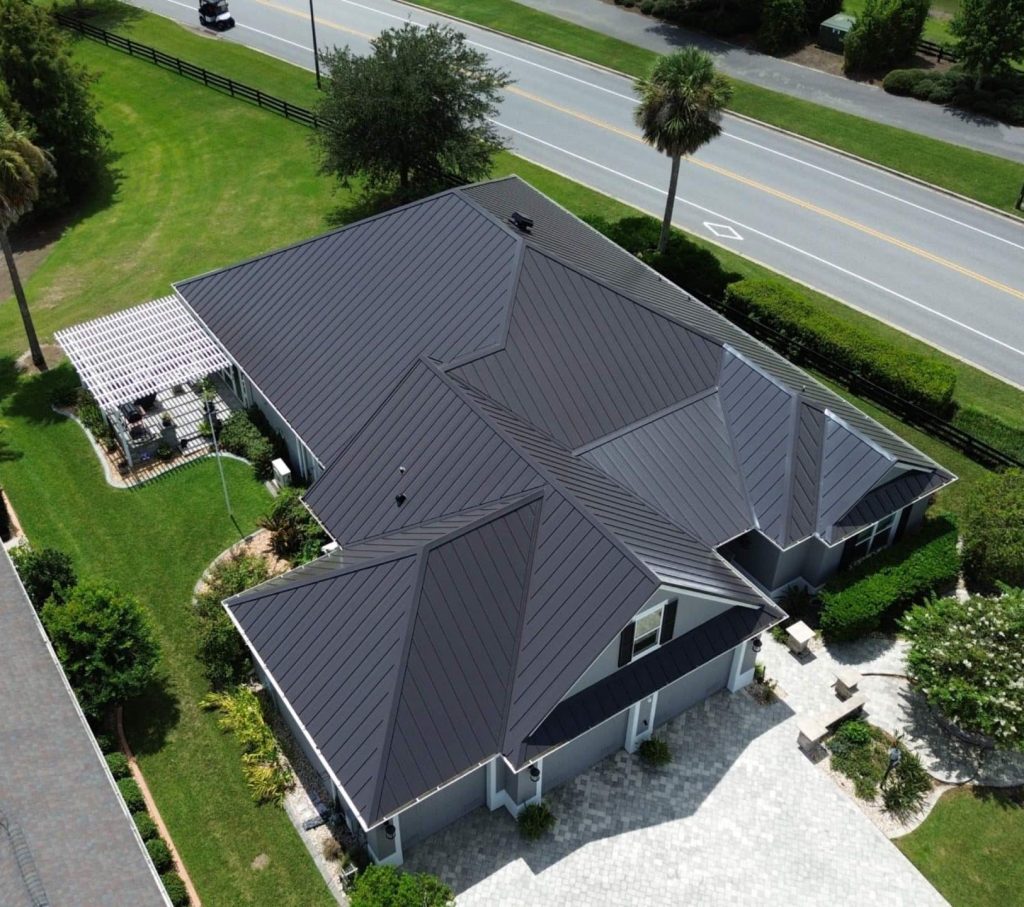
Standing seam panels solve that problem by design. Instead of screwing through the face of the panel, each panel has raised, interlocking edges that clip together and attach to hidden clips underneath. There are no exposed screw heads anywhere on the roof surface, which means there are no grommets to age out and no fastener holes for water to work through. It’s a cleaner look, too — just smooth, continuous panel lines from ridge to eave.
PRO TIP: We installed standing seam metal on our Orlando office. If you want to see what it looks like in person, it’s on our roof.
The trade-off is cost. Standing seam is a more involved installation and a more premium material, so it costs more than exposed-fastener metal or architectural shingles. For homeowners planning to stay in their home long-term, or who want to minimize maintenance calls down the road, that upfront cost is usually the point, not a downside.
Navigating HOA Rules in The Villages
The Villages is not one HOA — it has many districts, each with its own architectural review committee and its own rules about what roofing materials are allowed. This matters a great deal for standing seam metal, because approval has not always been uniform across the community.
Historically, District 5, on the original eastern/northern side of The Villages, did not approve standing seam metal roofing, while District 6 and several newer districts did. That meant the same roof that got approved without issue in one neighborhood could be denied a few miles away.
That’s changed. Under Florida House Bill 293, signed into law in May 2024, HOAs statewide — including every district in The Villages — can no longer flatly deny a homeowner’s application for hurricane protection that meets Florida Building Code standards, and that includes roof systems recognized under ASCE 7-22 wind standards. In practical terms, an HOA can no longer reject a metal roof application just because it’s metal.
What HOAs can still do is control the details: color, panel profile, and style, as long as those requirements are written into the HOA’s specifications and applied consistently.
Not sure what your district’s current specs allow? Ask Gold Key Roofing About HOA Approval
Because those written specifications still vary district by district, we recommend confirming the current color, style, and profile requirements with your HOA’s architectural review committee before finalizing a roofing decision. Gold Key Roofing has worked across multiple Villages districts, stays current on HB 293, and can help homeowners understand what their district actually requires before a proposal is ever submitted.
The 15-Year Insurance Cycle — and Why Standing Seam Fits It
More Florida insurance carriers are requiring roof replacement or re-inspection around the 15-year mark, regardless of how the roof is actually holding up. For homeowners facing that requirement, the decision isn’t just “what roof do I want” — it’s “what roof gets me the most value out of the next replacement cycle.”
Standing seam metal roofing is built to outlast that cycle by a wide margin, often with a functional lifespan measured in decades rather than years. For homeowners who know they’re going to face an insurance-driven replacement conversation again eventually, choosing a roof that performs well through repeated wind mitigation inspections and holds its integrity year after year can make the higher upfront investment easier to justify.
The Installation Process
We approached this project the same way we approach every full tear-off: remove the old roofing material down to the deck, inspect and repair the decking as needed, install a high temperature peel-n-stick underlayment rated for Florida’s heat and humidity, and then run the standing seam panels with fasteners from eave to ridge.
Because standing seam panels are custom-run to length, measurements have to be precise before the first panel goes down. Flashing details around penetrations, valleys, and roof-to-wall transitions also take more care than a standard shingle installation, since those are the areas most likely to leak if a metal roof is installed incorrectly.
The Results
The finished roof gives the homeowner a clean, modern standing seam profile with no exposed fasteners anywhere on the surface and a roofing system built to handle Central Florida storms for decades to come. Gold Key documented the project in full, from the original roof through the final panel installation, to show other Villages homeowners exactly what a standing seam project looks like from start to finish.
Frequently Asked Questions
Is standing seam metal roofing allowed everywhere in The Villages?
No. Approval depends on your specific district’s HOA architectural guidelines. Newer districts, including District 6, have approved standing seam, while some original districts, like District 5, currently do not allow it. Always confirm with your district’s review committee before choosing a material.
What’s the difference between standing seam and regular metal roofing?
Standing seam panels attach with hidden clips and have no exposed screws on the roof surface. Exposed-fastener metal roofing is screwed directly through the panel face, which relies on rubber grommets that can degrade and leak over time.
Is standing seam metal roofing more expensive?
Yes, standing seam typically costs more than exposed-fastener metal or asphalt shingles due to the material and the precision required during installation. Many homeowners find the added upfront cost worthwhile given the reduced maintenance and long service life.
How long does a standing seam metal roof last in Florida?
Standing seam metal roofs are built to last significantly longer than asphalt shingle roofs, with many systems performing well for decades when installed correctly. Actual lifespan depends on installation quality, maintenance, and local weather exposure.
Does standing seam metal hold up better in hurricanes?
Standing seam’s concealed fastening system and interlocking panels are generally more resistant to wind uplift than exposed-fastener systems, since there are fewer points where wind can catch and lift a panel edge. A licensed contractor should always confirm the correct panel and fastening specification for your home’s wind zone.
Considering a metal roof for your Villages, Ocala, or Orlando-area home? Gold Key Roofing has installed standing seam across Central Florida, including districts with strict HOA requirements, and can walk you through what’s approved in your community before you commit to a material.
Ready to talk metal roofing? Request a Free Estimate
